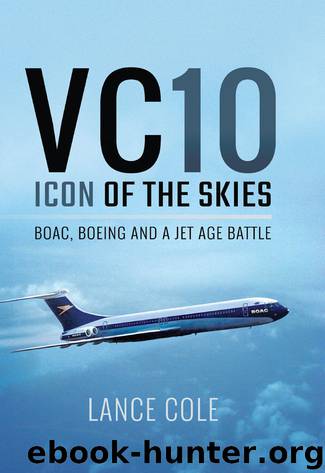
VC10: Icon of the Skies: BOAC, Boeing and a Jet Age Battle by Lance Cole
Author:Lance Cole [Cole, Lance]
Language: eng
Format: azw3
Publisher: Pen and Sword
Published: 2017-03-30T04:00:00+00:00
The flight deck was also spacious, well laid out, deeply windowed, and, as even admitted by Boeing 707 pilots, much easier to sit in and manage than their cramped, narrow, control post.
Fuselage and Wing Strength
The VC10 was a monocoque type fuselage structure, but was one that featured extra reinforcements in critical areas. Like a Saab, Volvo, or Mercedes car of the era, the VC10 body was a self-supporting monocoque type, yet one which benefited from over-engineered, extra stiff, localised reinforcements and strengthening to a degree not seen in simpler or cheaper (and lighter) mainstream structures. Of note, the VC10 design was the first time large jet engines had been paired at the rear of an airframe – requiring novel engineering solutions. Overall, throughout the VC10, a multiple load path network was built in – so if a part failed, other elements could absorb the failure and defuse any local fractures or cracks. The central cabin wing box and tail were incredibly strong, cabin and body apertures reinforced – milled from solid panels – and that central keel rail ran forwards to a nose/cockpit section of heavy duty formers, frames, and castings. The door frames were also heavily over-gauged and built up with massive support frames. The more usual practice of multi riveted, multi-welded, multi-panel work was avoided where possible. Huge chunks cut from solid metal alloys, and large machined skins, engendered high torsional rigidity. The wing was multi-spar with four main spar units and a massively strong centre box. This was a wing and hull without compromise. And it paid the price in weight – being several tonnes heavier than the 707 – for the VC10 was built like a proverbial (Vickers) battleship! Such construction saved the day and many lives in service.
Copper rich aluminium alloys and titanium alloys were used – at great expense. Panels were larger than those used by Boeing – so were stiffer and had fewer rivets and joints. The Vickers designers reduced the traditionally deployed numbers of lap joints, splices and seams along the window line – instead, using a machined from solid panel along the entire length of the window belt line. The window line panels were 34ft by 6ft and ¾ in thick. There were fewer crack-raising points and stiffening was integral – not add-on. Diagonally located load support beams, torque boxes, and massive cleating, all created a really strong structure. The additional skin cleats at each frame station would restrict any failure to one frame bay. Channel frames were doubled up with overlapping edges and the fuselage panels were laid transversely over their frames and with circumferential straps over them.
The crucial wing box and centre section, leading back to the very heavily reinforced tail area, was where the VC10s real heavy metal and strength was to be found. All this was new and required much design and testing, but it produced a very strong fuselage with no issues relating to potential pressurisation-cycle induced fatigue, and few of load and impact distress. With
Download
This site does not store any files on its server. We only index and link to content provided by other sites. Please contact the content providers to delete copyright contents if any and email us, we'll remove relevant links or contents immediately.
Personalized inhaled bacteriophage therapy for treatment of multidrug-resistant Pseudomonas aeruginosa in cystic fibrosis by unknow(179139)
CONSORT 2025 statement: updated guideline for reporting randomized trials by unknow(87680)
Critical evaluation of the ProfiLER-02 study design and outcomes by Vivek Subbiah & Razelle Kurzrock(87296)
Cardiac gene therapy makes a comeback by Oliver J. Müller & Susanne Hille & Anca Kliesow Remes(87061)
Whisky: Malt Whiskies of Scotland (Collins Little Books) by dominic roskrow(74445)
Unveiling the design rules for tunable emission in graphene quantum dots: A high-throughput TDDFT and machine learning perspective by Şener Özönder & Mustafa Coşkun Özdemir & Caner Ünlü(50898)
A yeast-based oral therapeutic delivers immune checkpoint inhibitors to reduce intestinal tumor burden by unknow(40267)
Covalent hitchhikers guide proteins to the nucleus by Alexander F. Russell & Madeline F. Currie & Champak Chatterjee(40218)
Meet the Authors: Christopher R. Mansfield and Emily R. Derbyshire by Christopher R. Mansfield & Emily R. Derbyshire(40100)
Alkaline-earth metals promote propane dehydrogenation with carbon dioxide through geometric effects: Altering the reaction pathway by unknow(32736)
Induced iron vacancies boosting FeOOH loaded on sustainable Fenton-like collagen fiber membrane for efficient removal of emerging contaminants by unknow(32513)
Efficient electric-field-assisted photochemical conversion of methane to n-propanol exclusively over penetrated TiO2Ti hollow fibers by Guanghui Feng(32456)
Bi2SiO5 nanosheets as piezo-photocatalyst for efficient degradation of 2,4-Dichlorophenol by Hangyu Shi & Yifu Li & Lishan Zhang & Guoguan Liu & Qian Zhang & Xuan Ru & Shan Zhong(32392)
A novel NDIPTA organic heterojunction photocatalyst with built-in electric field for efficient hydrogen production by Jiahui Yang & Baojun Ma & Yongfa Zhu(32367)
Enhanced conversion of methane to liquid-phase oxygenates via hollow ferrite nanotube@horseradish peroxidase based photoenzymatic catalysis by Jun Duan & Shiying Fan & Xinyong Li & Shaomin Liu(32333)
Ordered macroporous superstructure of defective carbon adorned with tiny cobalt sulfide for selective electrocatalytic hydrogenation of cinnamaldehyde by Xiao-Shi Yuan & Sheng-Hua Zhou & San-Mei Wang & Wenbo Wei & Xiaofang Li & Xin-Tao Wu & Qi-Long Zhu(32261)
What's Done in Darkness by Kayla Perrin(27154)
Topological analysis of non-conjugated ethylene oxide cored dendrimers decorated with tetraphenylethylene: Insights from degree-based descriptors using the polynomial approach by A Theertha Nair & D Antony Xavier & Annmaria Baby & S Akhila(26534)
Investigation of mechanical and self-healing properties of hydroxyl-terminated polybutadiene functionalized with 2-ureido-4-pyrimidinone by Mohsen Kazazi & Mehran Hayaty & Ali Mousaviazar(26461)
